About Diagonal Sudoku
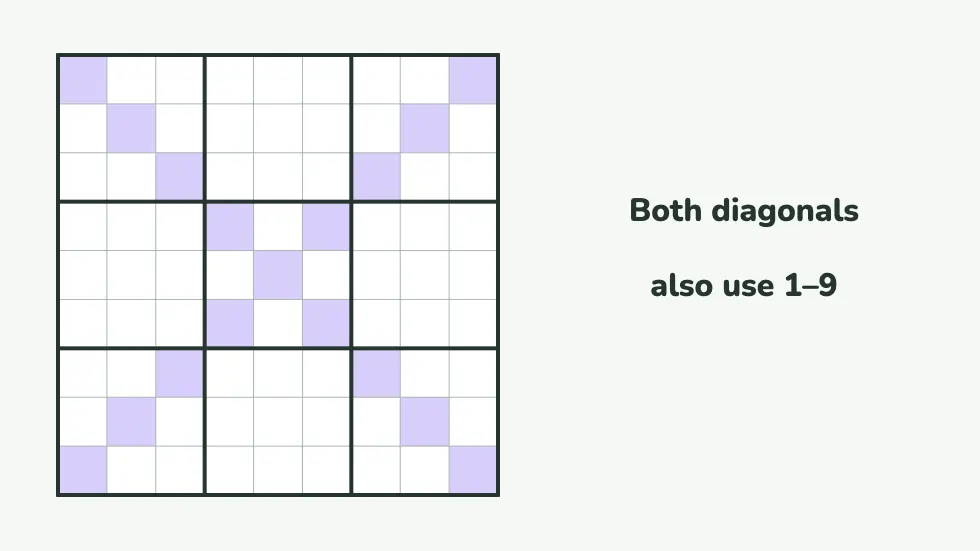
Diagonal Sudoku, also called Sudoku X, is classic sudoku with one extra rule: the two long diagonals, corner to corner, must each contain 1 to 9 exactly once as well. The shaded squares show where they run. It looks like a small change, and it is the gentlest step up from Classic.
How to play Diagonal Sudoku
- Every row, column and 3×3 box contains 1 to 9 exactly once.
- Both shaded diagonals also contain 1 to 9 exactly once.
- The centre square sits on both diagonals at once.
What the diagonals change
The diagonals are extra constraints, and extra constraints are extra information. A square on a diagonal belongs to at least four groups instead of three, so it has fewer possible digits. A square on a diagonal is often easier to pin down than one off it.
The habit to build: whenever you scan for where a digit can go, check the diagonals as well as the row, column and box. The centre square is the most constrained square on the board and often the first one you can fill.
Difficulty
Easy to Expert changes how many digits you start with, from 38 on Easy to 25 on Expert. Harder puzzles leave more of the work to the diagonals, so the extra rule matters more as the levels go up.
Controls
- Select a square, then use the number pad or keyboard.
- N toggles notes, Backspace erases, H gives a hint, U or Ctrl/Cmd+Z undoes.
- Progress and notes are saved for each variant separately.
Scoring
| Level | Base | Speed bonus, up to | Per mistake | Per hint |
|---|---|---|---|---|
| Easy | 1,000 | 250 | −100 | −250 |
| Medium | 2,000 | 500 | −200 | −500 |
| Hard | 3,500 | 875 | −350 | −875 |
| Expert | 5,000 | 1,250 | −500 | −1,250 |
Only fully solved puzzles are ranked. Your score is the difficulty base plus a speed bonus of at most 25% of that base. The bonus falls by 0.5 points per elapsed second, rounded to the nearest whole point, and never below zero. Each mistake deducts 10% of the base; each hint deducts 25%. A solved puzzle always earns at least 10% of its base. Undo does not refund time, mistakes or hints. Each Sudoku variant has its own leaderboard. Existing scores remain on the same boards; new solves use this formula.