

Every type of sudoku is built on the same idea: put each digit once in every row, every column and every region, until the grid has exactly one solution. The variants change one thing about that idea: the size of the grid, the shape of the regions, an extra line that must also hold every digit, or clues given as sums instead of numbers.
Here are the five you can play on this site, what each one changes, and which to try next.
At a glance
| Sudoku | Grid | What changes | Difficulty compared with Classic |
|---|---|---|---|
| 6×6 | 6×6 | Digits 1 to 6, boxes are 2×3 | Easier |
| Classic | 9×9 | Nothing, the original | The baseline |
| Diagonal | 9×9 | Both long diagonals also hold 1 to 9 | About the same, a little more to check |
| Jigsaw | 9×9 | Irregular regions replace the 3×3 boxes | Feels harder at first |
| Killer | 9×9 | Cages with sums, and no given digits | Harder |
Classic sudoku
The one everyone knows: a 9×9 grid split into nine 3×3 boxes, some digits given, and every row, column and box must hold 1 to 9 once. It is the reference point for every other variant, and still the best place to learn the techniques that all of them share: scanning for the only place a digit can go, and the only digit a square can take.
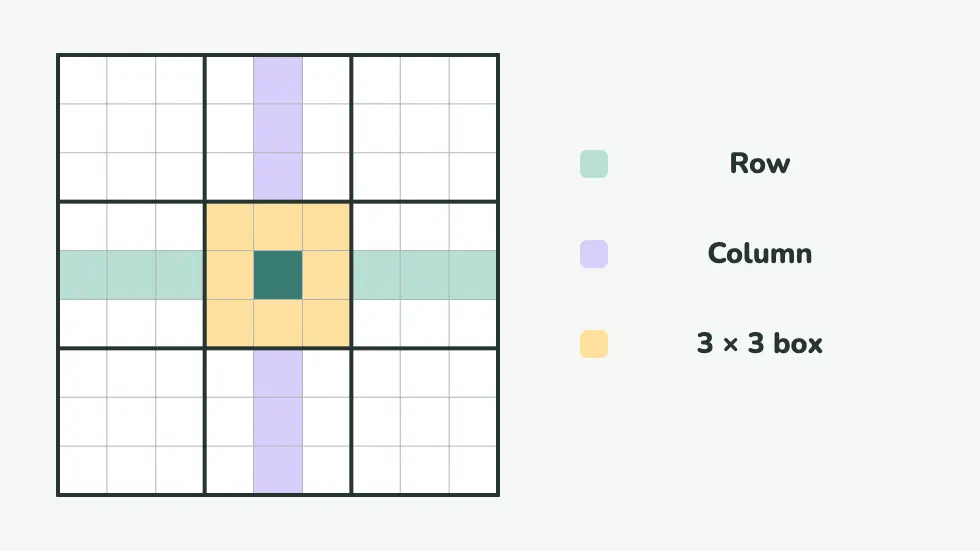
What makes one classic puzzle harder than another is not how many squares are empty, but which techniques it forces you to use. The levels are explained in how to solve sudoku.
6×6 sudoku
The same rules on a smaller grid: six rows, six columns and six boxes of two rows by three columns, filled with the digits 1 to 6. With 36 squares instead of 81, a puzzle takes a few minutes.
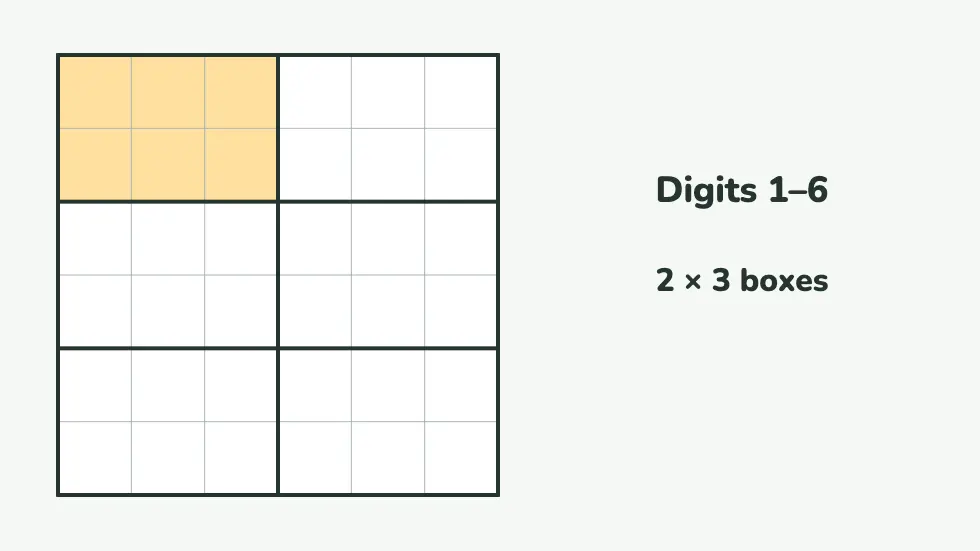
It is the best way into sudoku for beginners and children, because every technique that works on 6×6 works on 9×9 too. The grid is simply small enough to see all at once. If you can finish medium 6×6 puzzles without help, you are ready for an easy classic.
Diagonal sudoku
Also called Sudoku X. It is classic sudoku with one more rule: the two long diagonals, corner to corner, must each contain 1 to 9 exactly once.
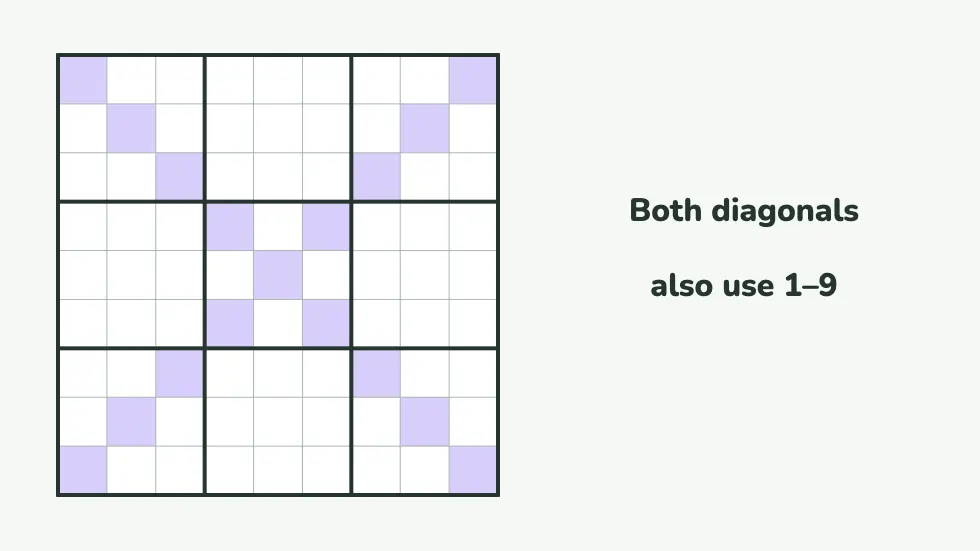
It sounds harder, and at first there is one more thing to check. But an extra rule is also extra information. A square on a diagonal belongs to four groups instead of three, so it has fewer possible digits, and the centre square, which sits on both diagonals, is often the first one you can place. Most players find a diagonal puzzle only a little harder than a classic one of the same level. It is the gentlest step away from the original.
Jigsaw sudoku
Also called irregular sudoku. The rows and columns stay, but the nine 3×3 boxes are replaced by nine irregular regions of nine squares each, outlined and coloured on the grid. Every row, column and region holds 1 to 9 once.
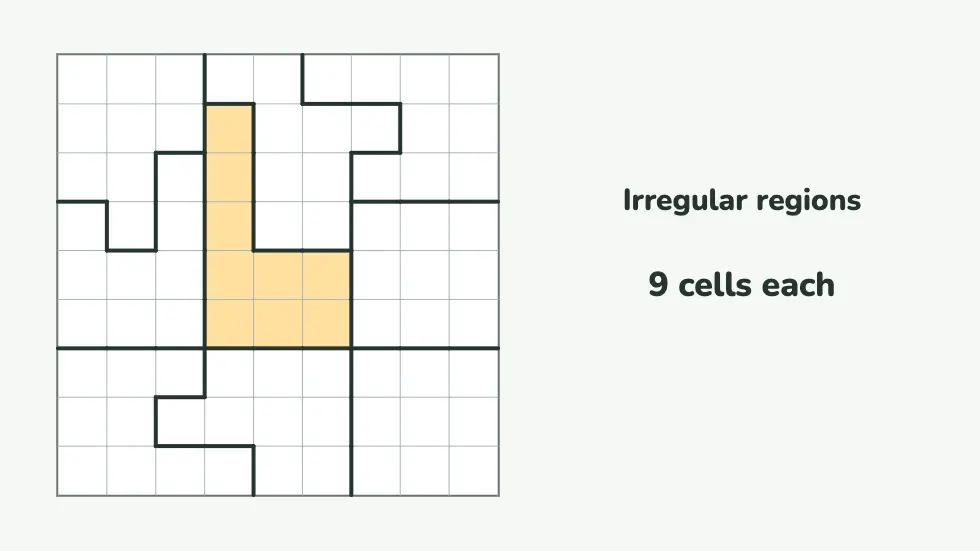
The rules are no more complicated than classic, yet the first few puzzles feel harder, because years of sudoku train your eye to read in neat boxes and the boxes are gone. The technique that helps most is counting: when a region pokes one square out of a group of rows, compare what the region still needs with what those rows still need. The square that sticks out often has only one possible digit.
Killer sudoku
The one with arithmetic. The grid follows the classic rules, and on top of them, dashed cages group squares together. The digits in each cage must add up to the small total in its corner, with no digit repeated inside a cage. Every killer puzzle here starts with no digits given at all.
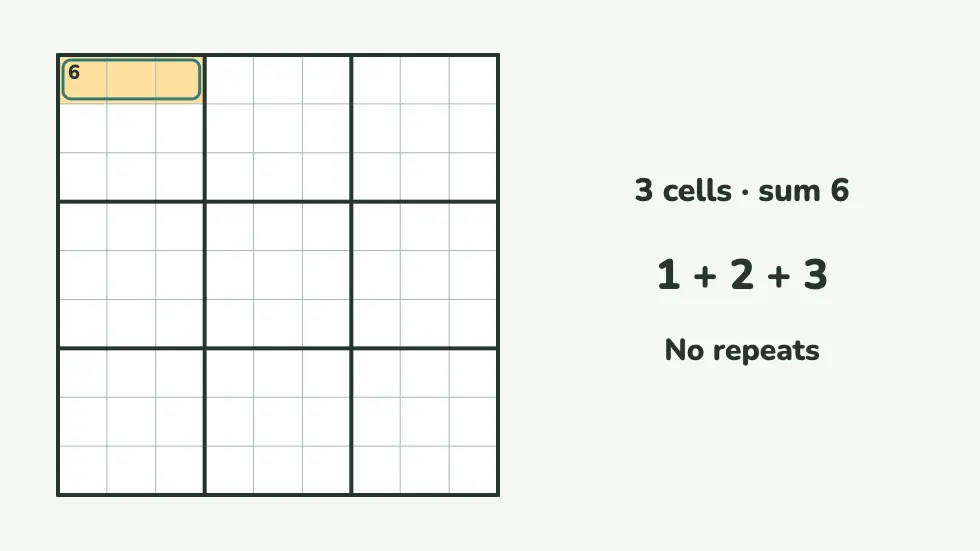
That changes how a puzzle opens. Instead of scanning for placements, you start from cages that can only be filled one way, like a two-square cage of 3, which must be 1 and 2, and from the fact that every row, column and box adds up to 45. Once a few digits are on the board it plays much like classic. The full method is in killer sudoku rules.
Other variants you may meet
These are not on the site yet, but you will see them in puzzle books and apps:
- 4×4 sudoku: the smallest version, digits 1 to 4, for young children.
- Samurai sudoku: five classic grids overlapping at the corners, solved together.
- Windoku, or hyper sudoku: four extra 3×3 regions inside the grid that must also hold 1 to 9.
- Even-odd sudoku: some squares are marked to take only even or only odd digits.
Which one should you play next?
- New to sudoku: start with 6×6, then move to Classic on easy.
- Comfortable with Classic: try Diagonal. It keeps everything you know and adds one rule.
- Classic feels routine: play Jigsaw. It breaks the box habit and makes familiar levels feel new.
- You want a real step up: go to Killer, starting on easy.
Every variant here is checked for exactly one solution under its own rules, keeps your notes and progress if you close the tab, and has its own leaderboard. Pick one in all sudoku games.