

Killer sudoku has two rules on top of ordinary sudoku. The digits in each dashed cage must add up to the number in its corner, and no digit can repeat inside a cage. Everything else is the classic game: every row, column and 3×3 box holds 1 to 9 exactly once.
What makes it feel different is the start. A killer puzzle here gives you no digits at all, only sums, so the first moves come from arithmetic rather than scanning. Here is how to get going in Killer Sudoku.
The rules
- Every row, column and 3×3 box contains 1 to 9 exactly once.
- The digits in each cage add up to the cage's total.
- A digit never appears twice in the same cage.
- Every puzzle has exactly one solution.
Start with the cages that have one answer
Some cages can only be filled one way. They are the first thing to look for on any killer board.
| Squares in cage | Total | Digits |
|---|---|---|
| 2 | 3 | 1, 2 |
| 2 | 4 | 1, 3 |
| 2 | 16 | 7, 9 |
| 2 | 17 | 8, 9 |
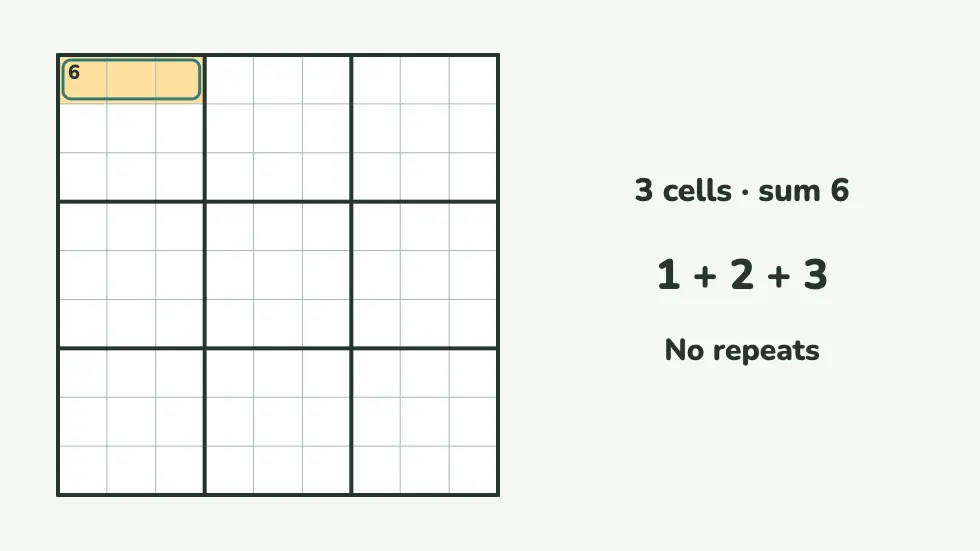
| 3 | 6 | 1, 2, 3 |
| 3 | 7 | 1, 2, 4 |
| 3 | 23 | 6, 8, 9 |
| 3 | 24 | 7, 8, 9 |
| 4 | 10 | 1, 2, 3, 4 |
| 4 | 30 | 6, 7, 8, 9 |
You will not know which square of the cage gets which digit yet, but you know which digits belong there. Pencil them in. That alone rules those digits out of the rest of the row, column or box the cage sits in.
The pattern behind the table: the smallest and largest totals for a cage of a given size have only one combination, and so do the totals just one step away from them.
The 45 rule
Every row, column and box holds 1 to 9 once, and 1 + 2 + … + 9 is 45. That one fact solves more killer puzzles than anything else.
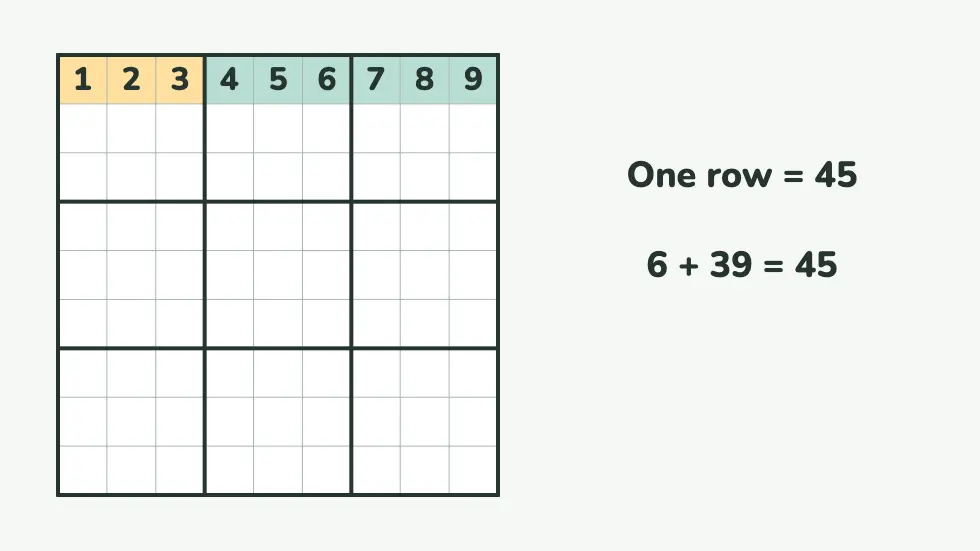
Take a 3×3 box. Add up the totals of the cages that sit entirely inside it. If they cover all but one square, that square is 45 minus their sum. If a cage pokes one square out of the box, the same subtraction tells you what that outside square is.
The same works for rows and columns, and for groups of them: two adjacent rows add up to 90, three to 135.
A first move, step by step
- Find the single-answer cages from the table and pencil in their digits.
- Pick the box with the most cages fully inside it and apply the 45 rule.
- Place whatever that gives you, then look for cages that now have only one way left to make their total.
- Once a few digits are on the board, switch to ordinary sudoku scanning. From here, the puzzle plays much like classic.
Common mistakes
- Repeating a digit in a cage. 6 in two squares is 3 + 3, and that is not allowed: a two-square 6 is 1 + 5 or 2 + 4.
- Forgetting that cages cross boxes. A cage can span two boxes, and its no-repeat rule still applies across the whole cage.
- Doing sums in your head. Write combinations down as notes. It is faster in the end than recalculating.
Killer or classic?
If you like classic sudoku because it never needs maths, killer will feel like a different game for the first few moves. If you like a puzzle where one subtraction unlocks half a box, it is the best variant there is. Try an easy one in Killer Sudoku, or see all the types of sudoku.