

The first player can always win Four in a Row. The game was solved in 1988, independently by James Dow Allen and Victor Allis: if you move first, drop your first disc in the centre column and play perfectly from there, the win is guaranteed. Nobody plays perfectly, though, and a handful of ideas will win you most games against people and plenty against the computer.
Try each of them in Four in a Row. If you want to test yourself against perfect play, choose Perfect and take the first move.
Why the centre matters
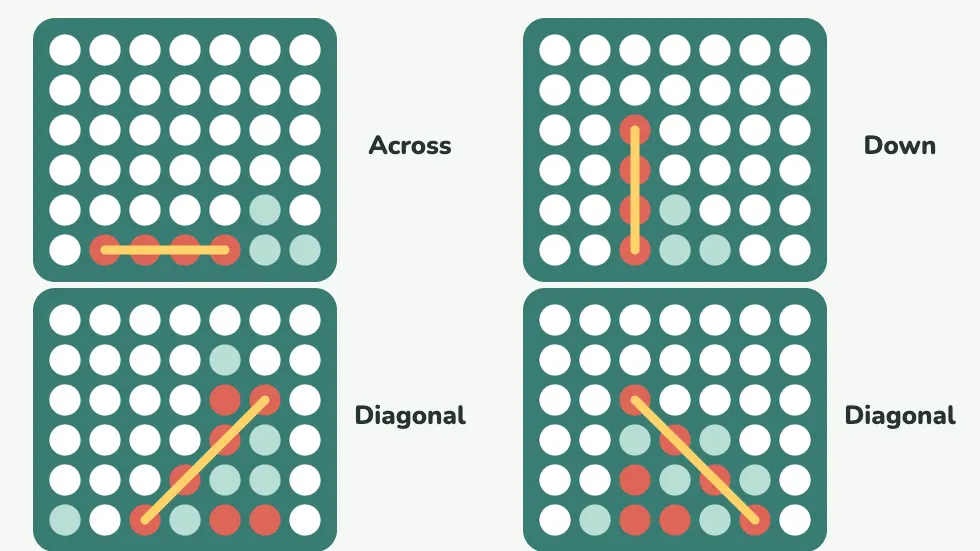
A board of seven columns and six rows has 69 possible lines of four. The centre column takes part in more of them than any other, so a disc there can still become part of more winning lines. That is why the winning first move is in the centre, and why the first move matters so much: started in the next column over, the second player can hold a draw, and started in one of the four outer columns, the second player can win.
As a rule for the whole game: the closer to the middle, the more lines a disc can join.
Count lines, not discs
Before each move, ask how many open lines of four the disc would join. A disc that sits on three possible lines is worth more than a disc that sits on one, even if the second one is next to your other discs. Strong players are thinking about empty lines, not existing ones.
Look at the space above
In Four in a Row, every move gives your opponent something: the space directly above your disc becomes playable. Before you drop a disc, check what that space would do for them. If it completes a line of theirs, you have just set up their win.
The same idea works for you. If you have a line of three with the fourth space floating in the air, your opponent cannot afford to play in the column beneath it. Each threat like that narrows the columns they can use.
Build two threats at once
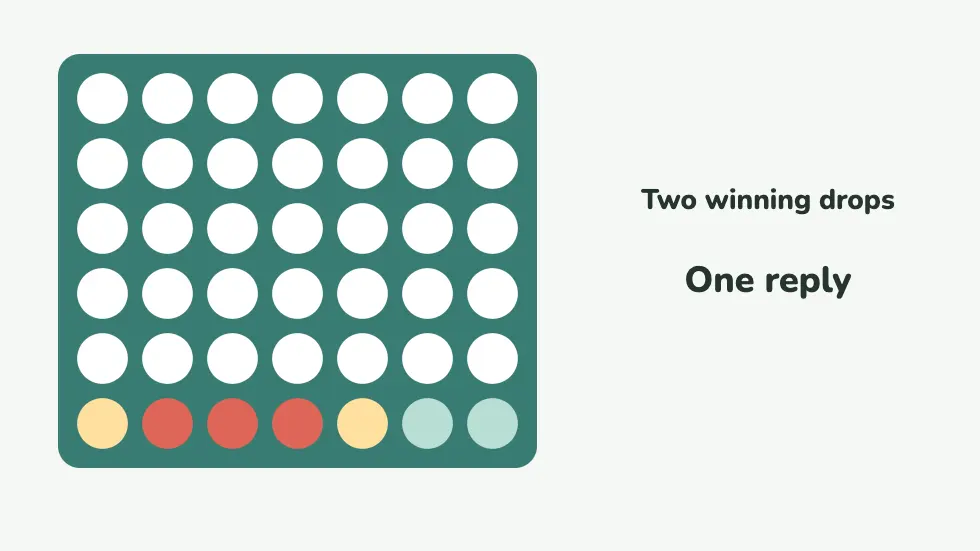
One threat can always be blocked. Two cannot. The winning move in most games is a disc that makes two lines of three at the same time, each with an open fourth space. Your opponent blocks one, and you complete the other.
Odd and even rows
This is the idea that separates good players from strong ones. Number the rows from the bottom, 1 to 6. With perfect play, the board tends to fill from the bottom in pairs, and that decides which threats come true.
- The first player wants threats on odd rows: 1, 3, 5.
- The second player wants threats on even rows: 2, 4, 6.
Why: each column has six spaces, an even number. If the second player answers every move by playing straight on top of it, the first player's discs end up on the odd rows and the second player's on the even ones. Late in a game, when nobody has a safe move left, that is roughly how the board fills. A threat on your rows is a space that eventually falls to you; a threat on the wrong rows usually gets filled by your opponent.
You do not need to calculate this all game. Just prefer threats on your rows, and be wary of your opponent's threats on theirs.
Against the computer
- Easy leaves openings. Practise building two threats at once.
- Medium blocks single threats reliably. You need double threats, or a threat on your row that it cannot avoid feeding.
- Perfect cannot be beaten when it moves first. When you move first, start in the centre, and expect to need every idea on this page.
Prove it
Win as the first player against Perfect and you have done something most players never do. Start in Four in a Row, or send a friend a link and see who reads the board better. For a duel on a smaller board, try Tic-Tac-Toe.