

Against a truly random opponent, there is no rock paper scissors strategy: every pick wins a third of the time, loses a third and draws a third, whatever you do. Against a person, it is different. People are bad at being random, and their patterns can be read.
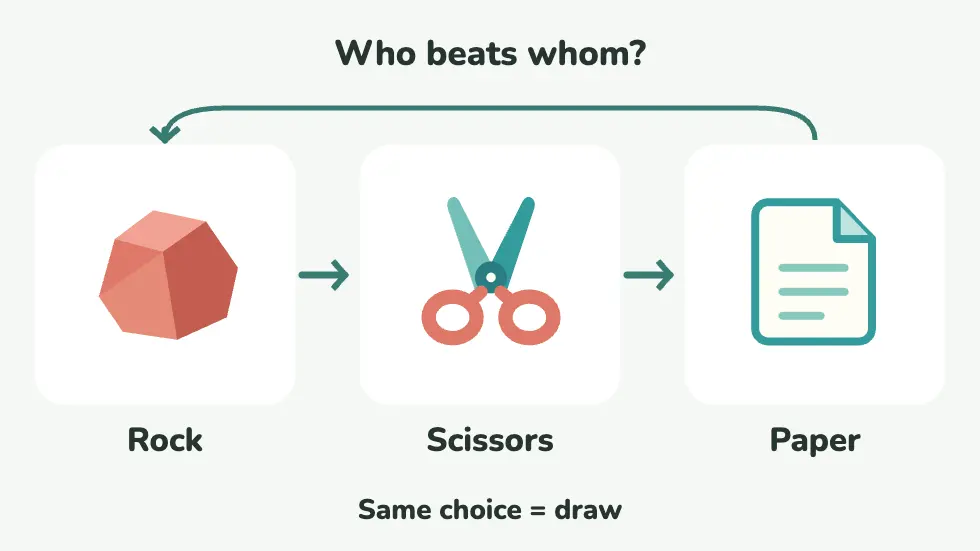
That is why the computer in Rock Paper Scissors is unbeatable over time, and a friend is not.
Why random always breaks even
If your opponent picks each option a third of the time, then whatever you choose, you face rock, paper and scissors equally often. One of those beats you, one loses to you and one is a draw. No sequence, trick or pattern of yours can change that, which is why the computer here picks at random.
The flip side: if you play at random, nobody can beat you over time either. Randomness is the perfect defence. It is only a poor attack.
How people actually play
People try to be unpredictable and end up predictable in familiar ways.
They avoid repeats. Asked to pick at random, most people switch more often than chance would. After two of the same pick, a third in a row comes up less often than one time in three.
Winners stay, losers shift. A study of several hundred players at Zhejiang University, published in 2014, found a common pattern: players who won a round tended to repeat their winning pick, and players who lost tended to switch to the next option in the cycle rock, paper, scissors.
Patterns show up under pressure. The longer a match goes, the more people fall into habits, especially when they are behind.
Using it
- After you win: your opponent just lost and is likely to switch, often to the next pick in the cycle rock, paper, scissors, rock. If they lost with scissors, expect rock, and play paper.
- After you lose: your opponent may stick with their winning pick. Play what beats it.
- After a run of the same pick: expect a change, and don't bet on a third repeat.
None of this works every time. These are tendencies, not rules, and a player who knows them can use them against you.
Don't be readable yourself
The best defence against all of the above is to avoid having a pattern. If you notice you always switch after a loss, stop doing it. Mix in repeats, mix in reversals. The more random you look, the less your opponent can take from you.
Play it properly
In person, someone always throws a fraction late. Online, your pick here is locked and hidden until both players have chosen, so the only thing left is reading each other. Send a friend a link in Rock Paper Scissors and find out who is more predictable, or play Tic-Tac-Toe for a duel where the right move can be worked out.