

English checkers is a draw with perfect play. That was proved in 2007, when Jonathan Schaeffer's team at the University of Alberta finished an eighteen-year computation with their program Chinook. But perfect play is a long way off for anyone, and games between people are won by a few habits: protect the back row, control the centre, and use the rule that captures are compulsory to make your opponent walk into your jumps.
Try them in Checkers, with English or Russian rules, against a friend or the computer on Easy, Medium or Hard. Most of this page applies to both; the differences are at the end.
The rules that shape strategy
Three rules decide most games of English checkers:
- Captures are compulsory. If you can jump, you must. That means you can force your opponent's moves.
- Ordinary pieces only move forwards. A piece that has moved up the board can never come back to defend.
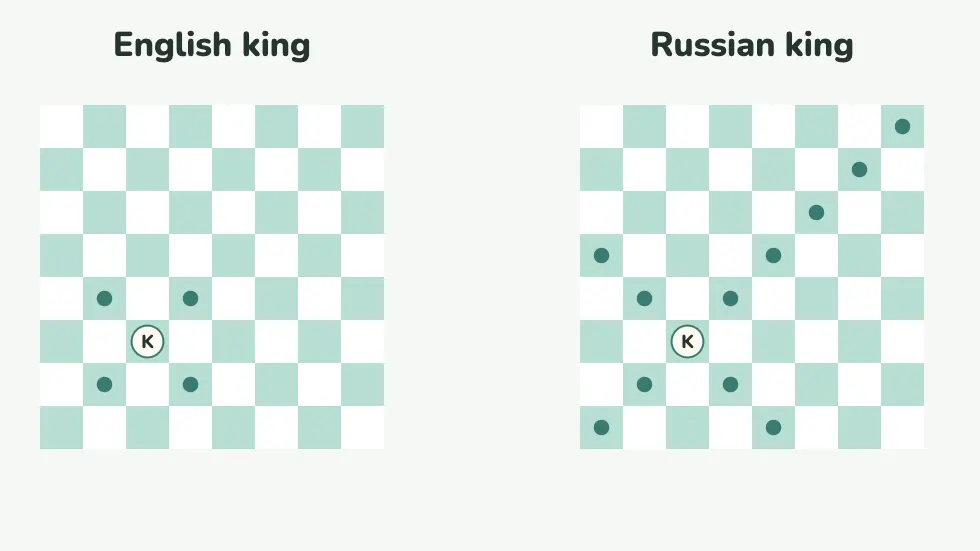
- Kings move one square at a time. They are strong, but slow, so a king is not a free win.
Russian checkers keeps the first rule and changes the other two, which is why its strategy shifts. More on that below.
1. Keep your back row
Your back row is where your opponent crowns kings. While your pieces stay there, nobody gets crowned. Most strong players keep two back-row pieces in place for as long as the game allows, typically the pair that covers the most squares an enemy piece could reach.
2. Control the centre
Pieces in the middle of the board have more squares to move to and more directions to support each other. Pieces on the edge are safe from being jumped from one side, but they have fewer moves and can be pinned in place. In the opening, move towards the centre.
3. Move in pairs
A piece that stands alone can be jumped. A piece with a friend directly behind it on the diagonal cannot be jumped from the front on that side, because there is no empty square to land on. Advance in pairs and triangles, not single files.
4. Use forced captures
This is where checkers is won. Because captures are compulsory, you can offer one piece knowing your opponent must take it, and choose where their piece lands. If it lands on a square that gives you a double jump, you have traded one piece for two. Before each move, check whether a sacrifice forces your opponent into a position you can jump twice.
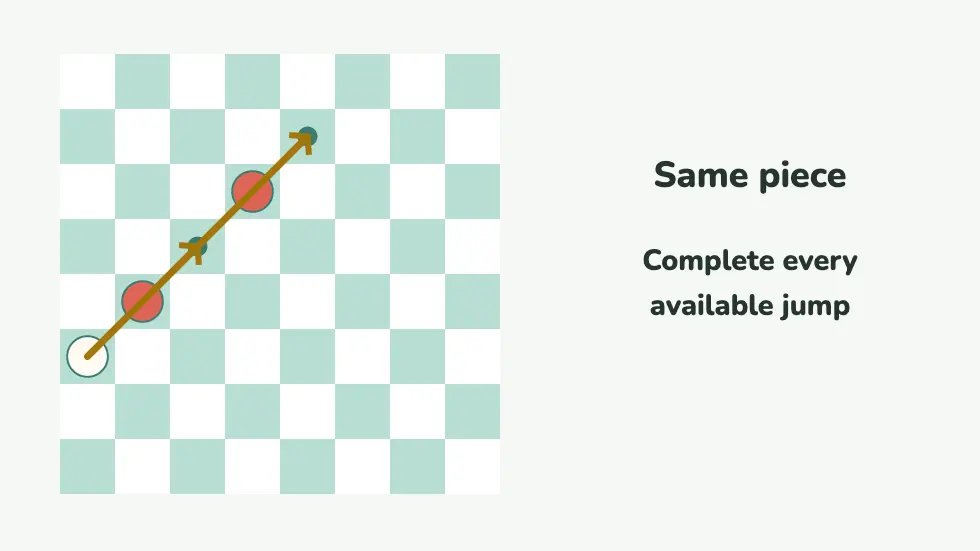
The same rule works against you. Before each move, ask what your opponent could force you to capture next turn, and where your piece would end up.
5. Count tempo
Since ordinary pieces only move forwards, every move uses up a little of your space. In the late middlegame, the player who runs out of safe moves first often has to give a piece away. Keeping a few spare moves in hand, pieces that can step forward without being exposed, is a quiet advantage.
6. Trade when you are ahead
With twelve pieces each, one extra piece is a small edge. With four against three, it is decisive. If you are a piece up, offer even trades, one for one. Every trade makes your extra piece count for more.
7. The ending
In English checkers, two kings against one is a win: you corner the lone king and close in. A single king against a single king is usually a draw. If you are behind, head for the double corner, where a lone king is hardest to trap.
What changes in Russian checkers
The same habits work, but three rules shift the balance.
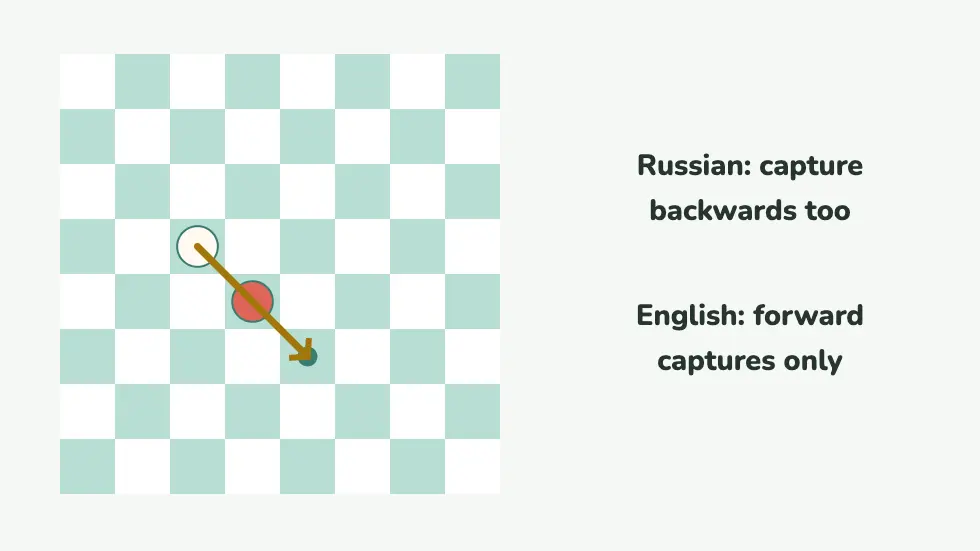
Backward captures make advanced pieces dangerous. An ordinary piece that has pushed deep into your half can still jump backwards, so it is not stranded the way it would be in English checkers. Count jumps in every direction, not just forwards.
Flying kings are worth far more. A king that can travel the full length of a diagonal and capture from a distance can hold off several ordinary pieces on its own. Getting the first king, and keeping it, often decides the game. Defend your back row even harder than in English checkers.
The long diagonal matters most. The main diagonal, corner to corner, is the longest line on the board. A king that controls it is very hard to trap, and in many endings one king on the long diagonal against three kings holds the draw. Try to claim it, and try to keep your opponent off it.
Combinations go further. Because a piece crowned during a capture keeps capturing as a king, a single sacrifice can open a chain that crosses the whole board. Look further ahead before every forced capture, yours and theirs.
Against the computer
- Easy leaves pieces unprotected. Practise spotting jumps and double jumps.
- Medium protects its pieces and punishes loose ones. Play in pairs, and look for forced captures.
- Hard rarely blunders. Aim for a solid position, trade when ahead, and treat a draw as a good result.
Prove it
Beat Hard once in each rule set, then send a friend a link and find out who has the better plan. Start in Checkers, or try Four in a Row for a faster duel.