

You cannot force a win at tic-tac-toe against a player who makes no mistakes: with perfect play from both sides, every game is a draw. But people make mistakes all the time, and a few simple rules will win you those games and make sure you never lose one yourself.
Try each of these against the computer in Tic-Tac-Toe. It plays the 3×3 board perfectly, so a draw against it is proof you have it down.
Why perfect play is a draw
There are 255,168 possible games of tic-tac-toe. X wins 131,184 of them, O wins 77,904 and 46,080 end in a draw. Going first is a real advantage: most finished games are won by X. But every one of those wins depends on a mistake somewhere. Two careful players will always draw.
Rule 1: take a corner or the centre first
As X, open in a corner or the centre. Both are safe. The corner is the better choice against people, because there is only one correct reply to it and many players get it wrong.
Rule 2: answer a corner with the centre
As O, if X opens in a corner, take the centre. Every other reply loses against good play. If X opens in the centre, take a corner. An edge square loses.
Rule 3: win if you can, block if you must
Every turn, check two things in this order. Can I complete a line now? If so, do it. Can my opponent complete a line next turn? If so, block it. It sounds obvious, and most lost games still break one of these two rules.
Rule 4: build a fork
A fork is a move that creates two lines of two at once. Your opponent can block only one, so you win the next turn. Almost every win against a decent player comes from a fork.
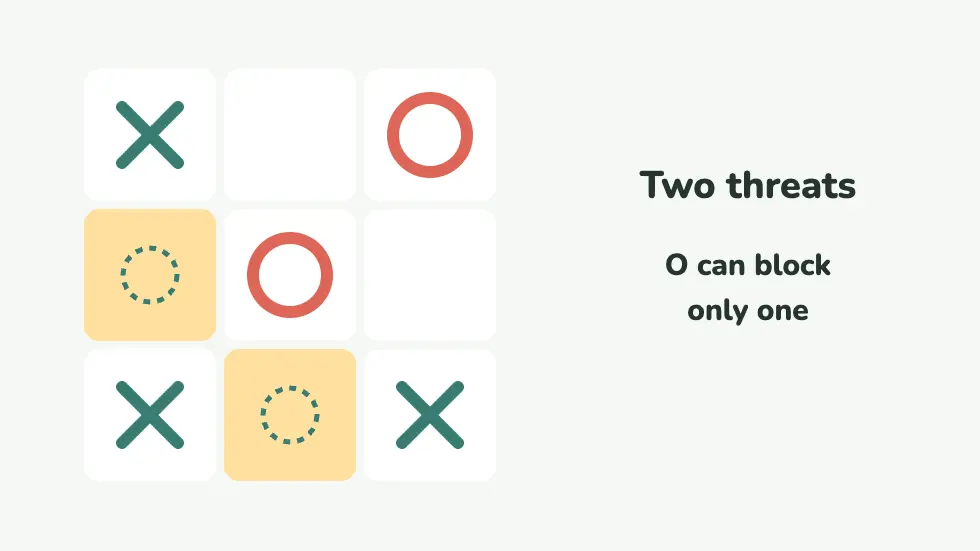
The classic one: X takes the top left corner and O replies on the edge next to it. X takes the centre, which forces O to block the bottom right. Now X takes the bottom left corner and threatens two lines at once, the left column and the other diagonal. O can only stop one.
Rule 5: stop their fork before it happens
If your opponent has two marks that could combine into a fork next turn, don't wait to block lines. Force them to answer you instead: make a line of two of your own somewhere they have to block. A forced move is a move they cannot spend on their fork.
Bigger boards
On 4×4 and 5×5 here you need four in a row. The same ideas apply, with more room:
- Blocking early matters more. On 5×5, three in a row with both ends open is already a double threat.
- Forks are easier to build and harder to see coming. Look for squares that sit on two of your possible lines at once.
- Unlike 3×3, the computer on 4×4 and 5×5 can be beaten.
Prove it
Play the computer on 3×3 ten times without losing, then send a friend a link and see whether they can do the same. Start in Tic-Tac-Toe, or move up to Four in a Row, where the same ideas of threats and forks decide a much bigger board.