About Dino T-Rex Runner
What Is the Dinosaur Game?
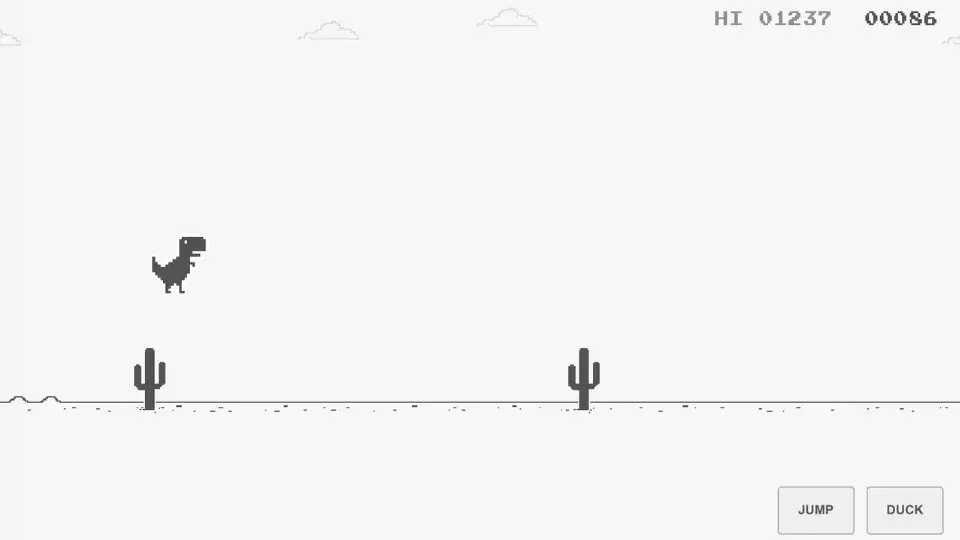
The Dinosaur Game, also known as the Chrome Dino, the T-Rex Runner or simply the no internet game, is a one button endless runner. A small grey Tyrannosaurus rex runs across a flat desert, and your only job is to keep it alive. Cacti come at you along the ground. Pterodactyls come at you through the air. Every second you survive adds to your score, and every few hundred points the whole world speeds up.
Most people meet it by accident. The WiFi drops, Chrome throws up its offline error page, and there in the middle of all that empty white space sits a dinosaur waiting to be poked. Nothing tells you it is a game. You just press a key and it starts moving.
The version on this page is the same run loop, but it does not need an outage to work. It loads in any modern browser, on a laptop or a phone, with nothing to install and no account to create.
How to Play the T-Rex Game
The whole game runs on three actions, which is exactly why it has lasted.
Desktop controls
| Action | Key |
|---|---|
| Start the run | Space |
| Jump | Space, Up arrow, W, or click the playfield |
| Duck | Down arrow or S |
| Restart after a crash | Space or Enter |
Mobile controls
| Action | Gesture |
|---|---|
| Start the run | Tap Start |
| Jump | Tap anywhere on the playfield, or the Jump button |
| Duck | Hold the Duck button |
| Restart after a crash | Tap Play again |
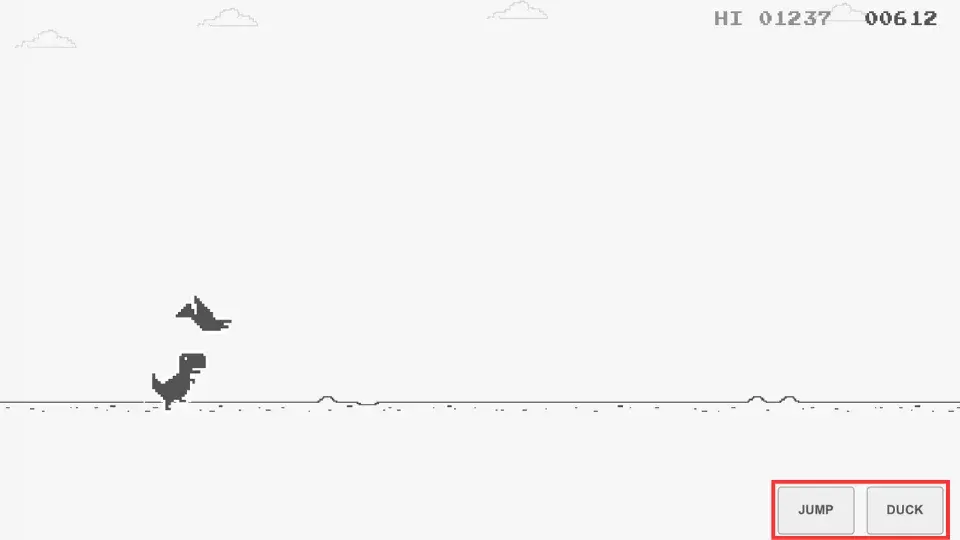
A short tap makes a short hop, and holding the jump key a fraction longer sends the dino higher. That difference sounds trivial until you meet a group of three tall cacti packed together, where a lazy full height jump lands you straight into the next one.
Obstacles, Speed and Night Mode
The game feeds you obstacles in a rough order, and knowing that order is most of the skill.
- Single cacti. The opening stretch. Easy to clear, easy to get complacent on.
- Cactus clusters. Two or three bunched together, cleared with one well timed jump rather than several small ones.
- Pterodactyls. They appear once you pass roughly 450 points. High ones can be run under, low ones must be jumped, and the ones at chest height need a duck.
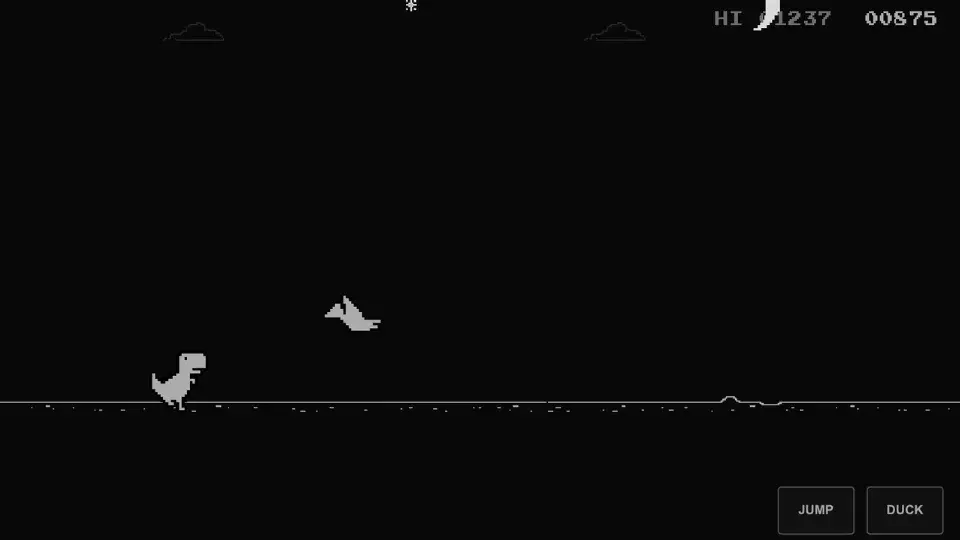
- Night mode. At 700 points the screen inverts to white on black for twelve seconds, then turns back. It happens again at every further multiple of 700, and it is not just decoration: the lower contrast genuinely costs you a few reaction frames until your eyes adjust.
Speed climbs the whole way up, and then stops. There is no level select, no difficulty setting and no checkpoint: the pace simply rises until it reaches the cap, which happens around 1,660 points, roughly two minutes in. Everything after that runs at one constant, very fast speed.
How to Get a Higher Score
A few things separate a 1,000 point run from a 10,000 point one.
- Watch ahead of the dinosaur, not at it. Put your eyes roughly two thirds of the way across the screen. You will see obstacles form before they matter.
- Jump late. Beginners jump the instant a cactus appears and land right on top of it. Give it another beat.
- Press duck in mid-air to cut a jump short. The dino drops three times faster, which saves a run when you have jumped too early or a low bird appears under you.
- Duck, do not jump, at pterodactyls. Ducking recovers faster, and you are back to a neutral stance sooner for whatever comes next.
- Stay ducked between close obstacles. The crouch hitbox is half the height of the standing one» вместо «smaller»
- Use headphones. The small beep that fires every 100 points gives you a rhythm to count speed increases against.
- Take breaks. Reaction time falls off noticeably after about fifteen minutes of trying. Most personal bests come from a fresh attempt, not the fortieth in a row.
Where the Chrome Dinosaur Came From
Chrome's designers built the runner into the offline page in 2014, with the last pieces landing in December of that year so older Android builds could handle it. The brief was small: give people stuck on an error screen something to do instead of an empty apology.
The dinosaur itself is a joke about the situation. No connection means prehistoric conditions, so the mascot is prehistoric too. Internally the project carried the name Project Bolan, a nod to Marc Bolan of the seventies band T. Rex. Early concepts gave the creature more personality, including animations for roaring and kicking, but those were dropped to keep the whole thing as blunt and readable as the error page around it.
What started as a throwaway easter egg now gets played hundreds of millions of times a month, which is an unusual fate for a feature nobody was supposed to look for.
What This Version Adds
Chrome's original forgets you the moment the connection comes back. This one does not. Your best score and the number of runs behind it are kept between visits, and signed in they follow you to another device and take their place on the game's leaderboard, which is the same board everyone else's runs land on. The sound has a mute button, and nothing here needs an outage, an install or an account to start.
Is the Dinosaur Game Endless?
Technically no, practically yes. The score counter was originally built around five digits, so 99,999 was the ceiling before it rolls over. Reaching it would take somewhere around seventeen million years of continuous running, a number the team picked deliberately because it lands in the neighbourhood of when actual tyrannosaurs were around.
What actually ends a run is the cap. Speed stops rising around 1,660 points, so from there the game is one unchanging sprint: no longer a test of whether you can keep up, but of how long you can hold that pace without a lapse. Nobody loses to acceleration; they lose to a blink.